Safety & Security
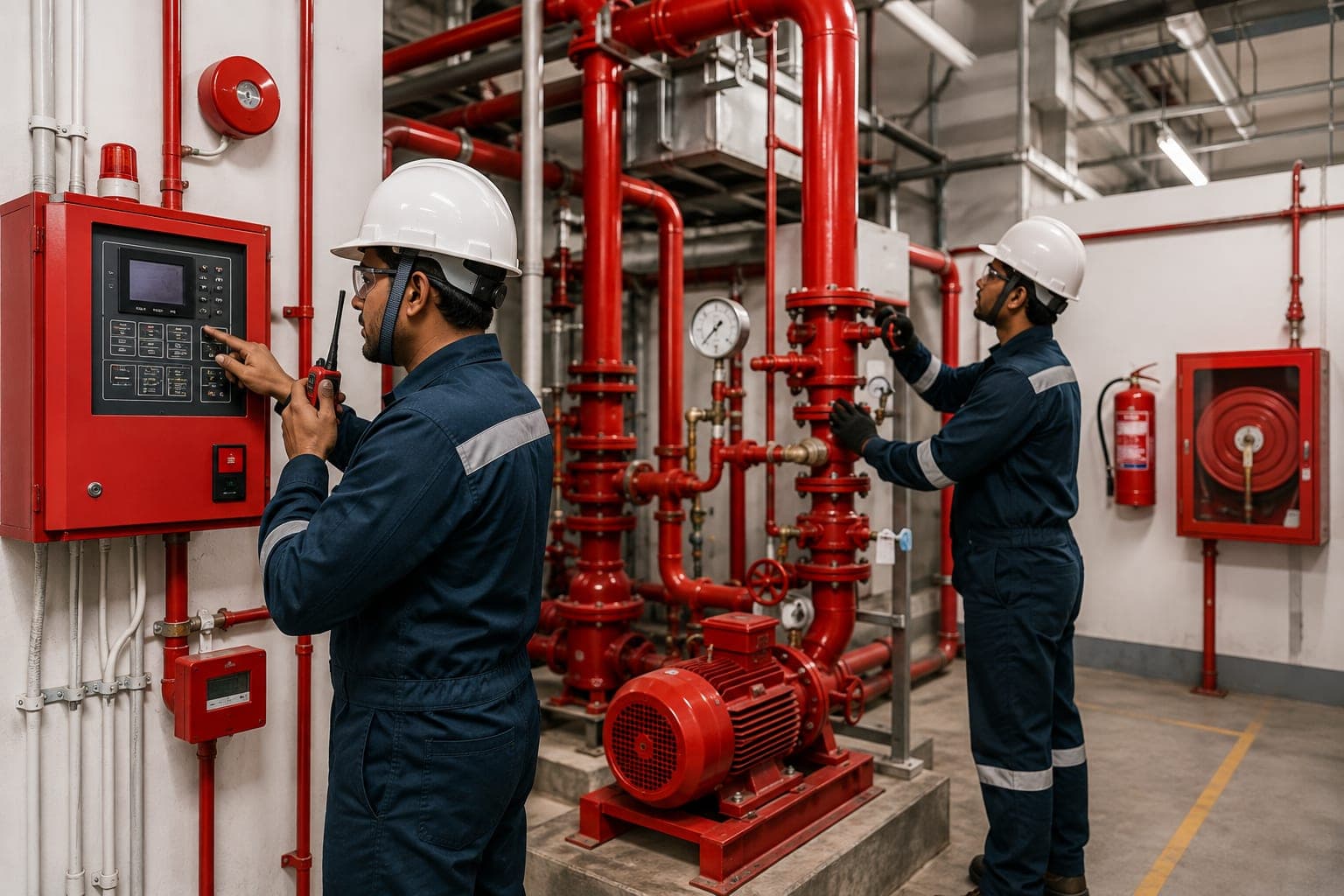
Firefighting Systems Installation & Maintenance
Design, installation, testing and maintenance of fire detection and suppression systems.
View details
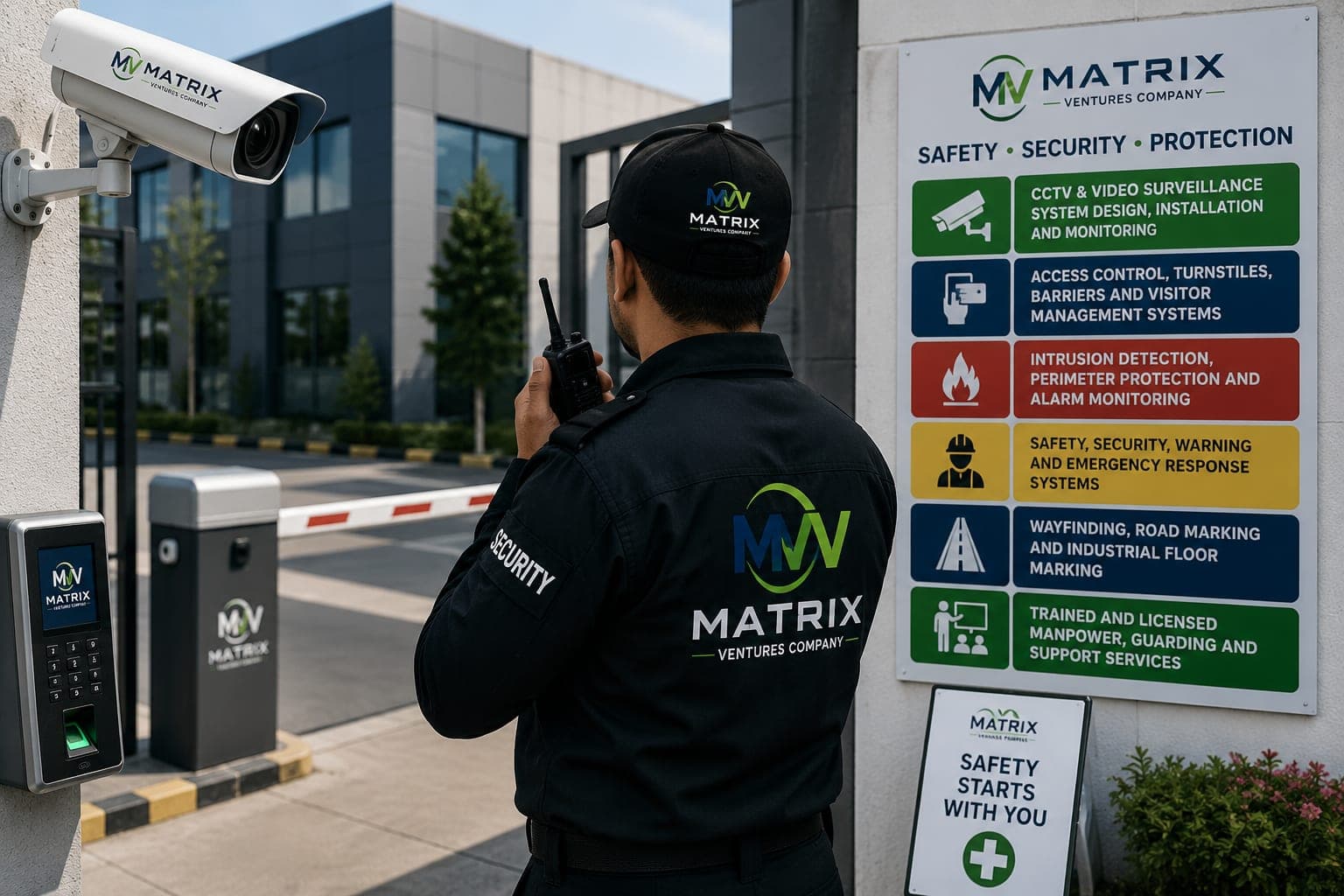
Electronic security systems, safety signage and manned security services.
A secure site combines three things: technology that sees, signage that instructs, and people who respond. We supply all three as one integrated service so that the control room, the wayfinding and the guard force operate to the same procedures.
Site security combines three layers that are usually procured separately: electronic systems that detect and record, signage that instructs people before an incident occurs, and a trained guard force that responds. Delivered together, the control room, the wayfinding scheme and the guarding roster operate to one set of procedures — so a camera alarm has a defined human response rather than a recording nobody was watching.
Security fails at the seams, not in the equipment. Cameras record an incident nobody responded to; access control is defeated by a propped door; signage warns of a hazard that moved two years ago. Each component can be individually compliant while the site remains exposed, because no single party owns the procedure that connects detection to response. Integrating the three layers is what turns equipment into actual security.
Plant boundary control, contractor screening and the access regimes industrial security directives require.
Perimeter protection, material and plant security, and gatehouse control on sites with high labour turnover.
Loading bay surveillance, vehicle movement control and stock-loss investigation support.
Public-facing access control, crowd flow signage and integrated alarm response.
Restricted-area control for pharmacy and records, plus wayfinding for visitors under stress.
Layered access, visitor management and auditable records of who entered which area and when.
The site is assessed for what actually needs protecting and from what: perimeter weak points, uncontrolled entries, blind spots, asset concentrations and the realistic threat profile. Equipment specified without this step tends to protect what is easy to cover rather than what matters.
CCTV coverage, access control zoning, intrusion detection and alarm handling are designed as one system with a defined operator response for each event type. Camera placement is specified against an identification requirement — detect, recognise or identify — rather than by counting cameras.
Safety, mandatory, warning and emergency egress signage is planned against the current layout and hazards, using recognised graphical symbols and bilingual text. Escape route signage is coordinated with the fire strategy rather than positioned by convenience.
Devices, cabling, controllers and recording infrastructure are installed and then hardened: default credentials changed, firmware updated, network segmentation applied and remote access controlled. Networked security equipment left at factory defaults is an entry point rather than a protection.
Licensed guards are deployed against a written assignment instruction covering post duties, patrol routes, escalation, incident reporting and emergency roles. Guards are inducted to the specific site rather than rotated in without briefing.
Alarms are monitored, incidents logged and reviewed, footage retained and disposed of in line with the retention policy, and the design reassessed when the site changes. A security system that is never audited degrades quietly until an incident tests it.
The party installing the cameras is the party staffing the response. An alarm has a named procedure and a person attached to it, rather than sitting between a systems integrator and a separate guarding contractor.
Signage is produced and installed alongside the security survey, so hazard warnings and escape routes reflect the current layout instead of a superseded one.
Manned guarding is provided within the licensing framework that private security in the Kingdom requires, with vetted and trained personnel rather than general labour on a gate.
Camera coverage, retention periods, access to footage and signage notifying people of recording are specified up front, because surveillance data is regulated personal data and not merely an operational asset.
System faults, guarding performance and signage changes are raised with one party, which removes the familiar argument about whether a failure was equipment or manning.
Private security guarding in the Kingdom is a licensed activity regulated by the Ministry of Interior, covering company licensing and the vetting and training of guards. Engaging unlicensed guarding exposes the client as well as the provider, which is why licensing status is worth confirming before a contract rather than after an incident.
Video surveillance captures personal data and therefore falls under the Saudi Personal Data Protection Law, overseen by the Saudi Data and Artificial Intelligence Authority. That brings obligations around lawful purpose, proportionate coverage, notifying people that recording takes place, restricting who can access footage, and defining a retention period rather than keeping recordings indefinitely.
Cameras, recorders and access controllers are network devices. Where a facility falls within the scope of the National Cybersecurity Authority's controls, these systems are part of the protected estate and are expected to be hardened, patched and segmented rather than connected flat to the corporate network.
Emergency egress signage, illumination and directional marking are governed by the fire and life safety requirements of the Saudi Building Code and are subject to Civil Defence inspection. Graphical safety symbols are commonly specified to ISO 7010 so that meaning does not depend on the reader's language.
Facilities under the High Commission for Industrial Security apply its directives on perimeter protection, access control and personnel screening. These are typically more prescriptive than commercial practice and are a design constraint rather than a preference.
Codes and standards this discipline is routinely held to. The standards applied on any given project are those named in the contract.
Yes. Private security guarding is a regulated activity licensed by the Ministry of Interior, and guards are subject to vetting and training requirements. Using an unlicensed provider creates exposure for the client too, so licensing status should be confirmed at contract stage rather than assumed.
Yes — footage that can identify a person is personal data under the Saudi Personal Data Protection Law. In practice that means surveillance needs a lawful purpose, coverage proportionate to that purpose, signage telling people recording is taking place, controlled access to footage, and a defined retention period after which recordings are deleted. Keeping everything forever is not a neutral default.
That is the wrong starting question. The right one is what each view has to achieve — detect that someone is present, recognise a known individual, or identify an unknown one — because that determines pixel density, lens choice and mounting position. A smaller number of correctly specified cameras outperforms a larger number placed to satisfy a count.
Yes, subject to a condition survey. That review typically covers coverage gaps, recording retention and whether it is actually working, device firmware and credential status, and whether alarms currently have a defined response. Monitoring a system without knowing its gaps produces a staffed control room and the same blind spots.
It depends on the occupancy and hazards, but emergency egress signage and illumination are governed by the fire and life safety requirements of the Saudi Building Code and inspected by Civil Defence. Beyond that, mandatory, warning and prohibition signage follows the hazards actually present. Signage is a compliance item at inspection, not decoration.
Through a visitor management process rather than a paper log: pre-registration where possible, identity verification at the gate, induction status checked before site entry, time-bound access rights, and an auditable record of who was where. On industrial sites this also has to align with the operator's own screening requirements.
They can be, and frequently are. Cameras, recorders and door controllers are networked computers; left on default credentials, unpatched, and connected to the same flat network as business systems, they become an easy entry point. Hardening, patching and network segmentation are part of the installation, not an optional extra.
Yes, and the reverse is also available — systems without guarding, or signage on its own. The integrated model is offered because it removes the response gap, not because the elements cannot be bought separately.