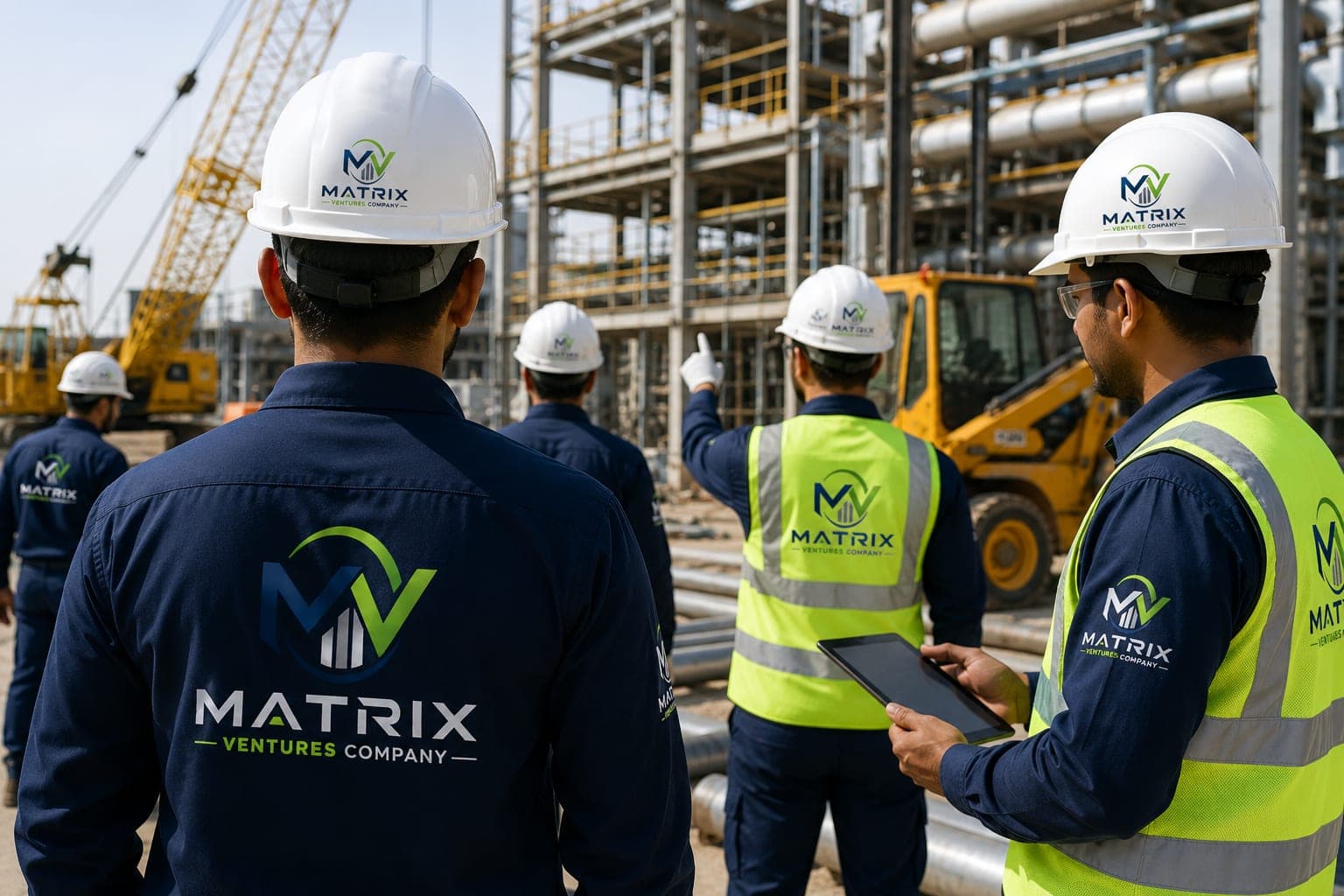
Engineering & Construction
Civil, Mechanical, Electrical & Instrumentation Construction & Maintenance Services
Multi-discipline construction and maintenance across civil, mechanical, electrical and E&I works.
View details

Technique-led industrial services that require dedicated equipment and certified operators.
Some scopes cannot be covered by a general workforce. This service line brings certified specialists and purpose-built equipment for the industrial tasks that sit outside routine construction and maintenance.
Specialised industrial and technical services are the technique-dependent trades that require dedicated equipment and formally certified operators rather than general construction labour. They include scaffolding, surface preparation and protective coating, thermal and acoustic insulation, industrial and high-pressure cleaning, non-destructive testing support, and controlled entry into confined spaces. On most industrial projects these trades do not sit at the end of the programme — they gate access to it.
These trades are routinely treated as support activities and priced as an afterthought, yet they determine whether the primary work can start at all. A mechanical crew cannot reach a flange without scaffold, cannot enter a vessel until it has been cleaned and gas tested, and cannot close out a weld until it has been examined. Under-resourcing them does not save cost — it converts specialist labour into idle mechanical labour, which is more expensive.
Vessel and exchanger cleaning, corrosion under insulation programmes, and the scaffold access that every turnaround front depends on.
Boiler and condenser cleaning, high-temperature insulation and coating systems for marine and humid service.
Line and tank cleaning between product campaigns, plus structural steel protection and repainting.
Sludge removal, internal blasting and lining, and floor-plate examination during statutory tank inspection.
Access scaffolding, protective coating and structural inspection support on bridges, towers and civil assets.
Abrasion-resistant lining, silo and hopper cleaning, and wear-surface renewal in high-erosion service.
The substrate, environment and service conditions decide the method: which abrasive and profile, which coating system, which insulation material, which NDT technique for the flaw type expected. Selecting on the basis of familiarity rather than condition is the most common source of premature failure.
Scaffolding is designed for the loads and access it must carry, not improvised. Confined space entry, hot work and energy isolation are permitted under the operator's system, with gas testing, standby attendants and a rescue plan in place before entry — not arranged once a crew is waiting.
Preparation is executed and verified to the specified visual standard and profile, with containment, extraction and waste capture appropriate to the abrasive and the surrounding plant. Coating adhesion is determined almost entirely at this stage, and it cannot be recovered later.
Coatings are applied within the manufacturer's stated conditions for temperature, humidity, dew point and overcoat window, with wet and dry film thickness recorded as work proceeds. Insulation and cladding are installed with attention to vapour barriers and terminations, which is where corrosion under insulation begins.
NDT is carried out by qualified technicians to a written practice, with reports issued against the acceptance criteria in the applicable code. Coating inspection covers thickness, holiday detection and adhesion. The output is a record, not an opinion.
Insulation and cladding are reinstated, scaffolding is dismantled in a controlled sequence once the trades it served have signed off, and waste — abrasive, sludge, spent chemicals — is routed to licensed disposal. Scaffold left standing after it is needed is both a cost and a hazard.
These trades are the ones most often subcontracted twice over on industrial projects. Holding them inside the same organisation means one safety system, one competency standard and no gap between the party planning access and the party providing it.
When scaffolding is scheduled as part of the same programme as the mechanical scope, erection and dismantling sit on the plan rather than interrupting it — which is what removes standing time from the critical path.
Scaffold erectors and inspectors, coating applicators, NDT technicians and confined space attendants work to formal qualification. Competency is documented and auditable rather than assumed from experience.
Spent abrasive, tank sludge, coating residues and cleaning effluent are classified and routed to licensed disposal. Waste is planned before it is generated, because on-site storage is normally the binding constraint.
Scaffold, insulation strip, cleaning, inspection, coating and reinstatement are sequential and interdependent. Delivering them together avoids the handover losses that occur when each step waits on a different supplier.
Scaffolding must be erected, altered and dismantled by trained personnel and inspected before first use and at defined intervals, with a tagging system that makes its status visible to every user. Industrial sites additionally apply the operator's own scaffold standard, which frequently exceeds the general requirement.
Entry into vessels, tanks, pits and other confined spaces is permit-controlled: atmospheric testing for oxygen, flammable gas and toxic contaminants, continuous monitoring where required, a dedicated attendant, controlled entry logging and a rescue plan that does not rely on the site emergency service alone.
Facilities under the High Commission for Industrial Security apply its directives to contractor activity inside the plant boundary, including personnel screening, equipment entry control and the fire and emergency provisions that must be in place before hot work or entry is authorised.
Preparation grades are normally specified to ISO 8501, and protective coating systems for corrosivity category and design life to ISO 12944 or the equivalent AMPP (formerly NACE and SSPC) standards. Acceptance is measured — profile, thickness, adhesion, holiday detection — rather than judged visually alone.
Non-destructive testing personnel are qualified and certified to a written practice based on ASNT SNT-TC-1A or to ISO 9712, at the level appropriate to the technique and the responsibility held. Procedures and acceptance criteria follow the construction code governing the item under examination.
Codes and standards this discipline is routinely held to. The standards applied on any given project are those named in the contract.
Because it is a predecessor to almost everything and is usually planned last. Every mechanical, inspection, insulation and coating front needs access, and those fronts often peak simultaneously. If scaffold crews are sized for average demand rather than peak, the whole outage queues behind them.
It is corrosion of pipework or equipment hidden beneath insulation, driven by moisture ingress at damaged cladding, poor terminations or failed vapour barriers. It matters because it is invisible during normal operation and is often only found when insulation is stripped — by which time wall loss can be significant. Managing it is a survey and reinstatement discipline, not just an insulation one.
The conventional methods used for weld and in-service examination: visual, dye penetrant, magnetic particle, ultrasonic and radiographic testing, with technique and acceptance criteria set by the governing construction or inspection code. Method selection follows the flaw type and orientation expected, since no single technique detects everything.
It is classified according to what it contains — hydrocarbon sludge, spent abrasive, chemical residues, contaminated water — and routed to a licensed disposal or treatment facility under Saudi environmental requirements. Disposal routes and capacity are arranged before cleaning starts, because temporary storage on a live site is normally the limiting factor.
Yes, under the operator's permit system and with equipment appropriate to the area classification. That usually means air-driven or certified tooling, continuous gas monitoring, controlled ignition sources and hot work permits where any spark-producing activity is unavoidable.
By measurement at each stage: surface cleanliness and profile before application, ambient and substrate temperature and dew point at application, wet and dry film thickness during and after, then adhesion testing and holiday detection where the specification calls for it. The record set is what demonstrates the system will reach its design life.
No. They are available as a standalone appointment supporting another contractor's work or an operator's own maintenance team, as well as bundled with a wider construction or turnaround scope.
Overwhelmingly, surface preparation and application conditions rather than the product itself. A premium coating applied over an inadequate profile, on a damp substrate, or outside its overcoat window will underperform a modest system applied correctly. This is why preparation is inspected and recorded rather than assumed.
Engineering & Construction
Multi-discipline construction and maintenance across civil, mechanical, electrical and E&I works.
View details
Engineering & Construction
Concept-to-completion design, detailed engineering and independent project management consultancy.
View details
Engineering & Construction
Plant construction and maintenance, plus planned shutdown and turnaround execution.
View details