
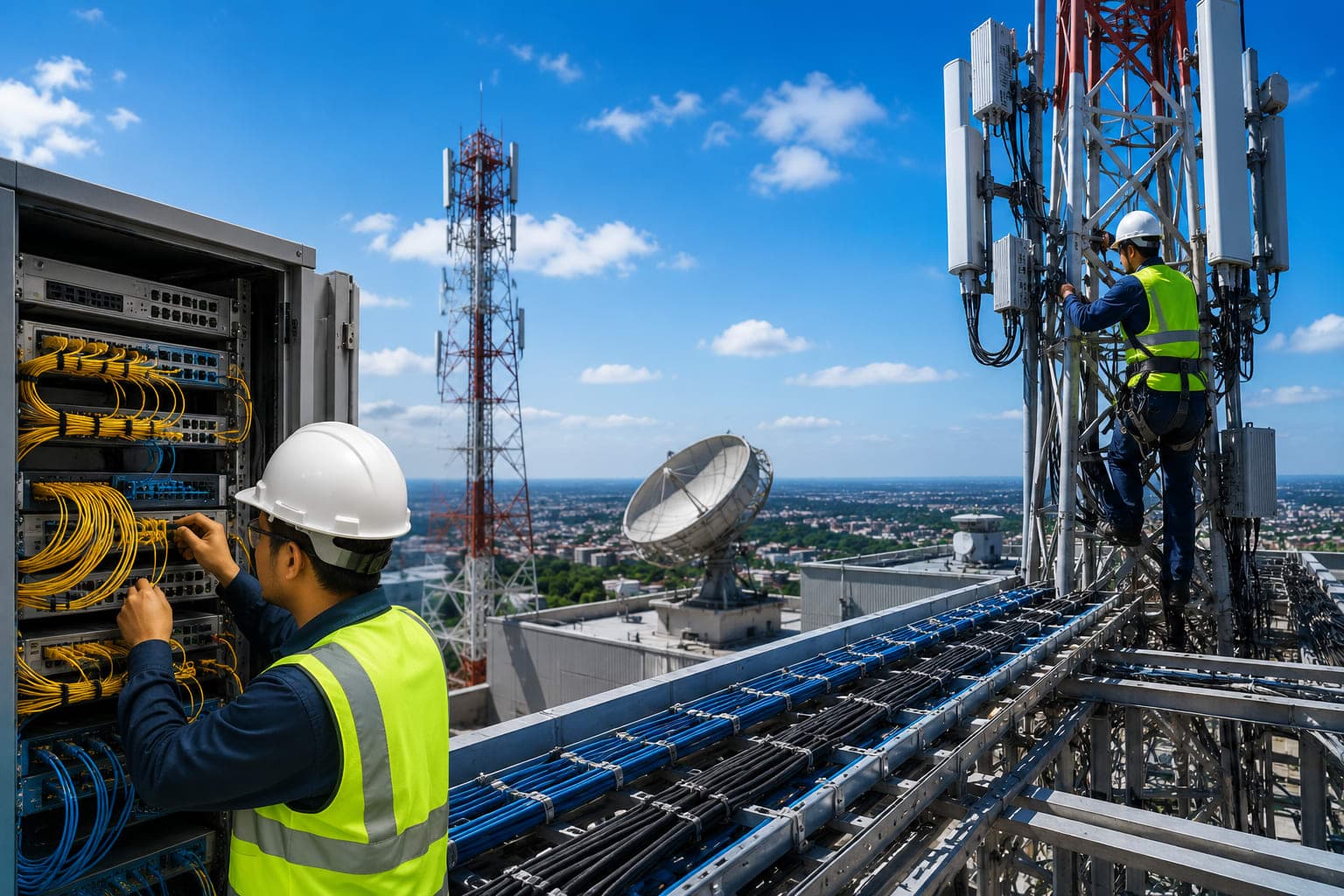
Telecommunication Works
Structured cabling, fibre optic networks, towers and communication infrastructure.
We build the physical layer that everything else depends on — from the fibre in the ground to the racks in the equipment room — and we test and certify every link before handover.
Scope of Work
- Structured cabling: copper and fibre optic, indoor and outdoor
- Fibre optic splicing, termination, OTDR testing and certification
- Telecom towers, masts, antenna installation and alignment
- Data centre and equipment room fit-out, racking and containment
- Ducting, trenching, manholes and underground network routing
- Public address, intercom, IPTV and two-way radio systems
What is Telecommunication Works?
Telecommunication works are the construction of the physical layer that carries every network service: copper and fibre optic cabling, splicing and termination, the ducts and trenches that route it underground, the towers and masts that carry antennas, and the equipment rooms and data centre racks it terminates into. The defining deliverable is not that a cable exists but that every link has been tested and certified to a measured performance standard before handover.
Why it matters
Cabling is installed once and lives behind walls, in ceilings and under ground for fifteen to twenty-five years, while the equipment plugged into it is replaced several times over that period. That asymmetry is why the physical layer deserves more attention than it usually gets: a poorly terminated link is cheap to prevent and expensive to find, because intermittent faults present as application problems and get chased through switches and servers long before anyone suspects the cable.
Who needs this service?
- Developers and building owners requiring structured cabling in a new or refurbished facility
- Industrial plants extending network infrastructure into process and hazardous areas
- Telecom operators and tower companies needing installation, upgrade or maintenance crews
- Data centre and equipment room projects requiring racking, containment and patching
- Campuses and industrial estates needing underground duct routes between buildings
- Facilities whose existing cabling is undocumented, uncertified or has outgrown its capacity
When to engage this service
- A new building or fit-out requires structured cabling designed and certified before occupancy
- Fibre must be routed between buildings, and duct, trenching and permits are required
- A tower or mast requires installation, antenna alignment, or structural and safety inspection
- An equipment room or data centre needs racking, containment, patching and labelling
- Existing cabling is undocumented, so faults cannot be traced and moves or changes are guesswork
- Network performance problems are suspected to originate in the physical layer rather than the equipment
Industries served
Telecom Operators
Tower works, antenna installation and alignment, fibre backhaul routing and network element installation.
Oil, Gas & Petrochemicals
Network infrastructure into classified areas, where cable, glands and enclosures must suit the area classification.
Commercial Buildings
Structured cabling, containment and equipment rooms coordinated with the wider MEP fit-out programme.
Campuses & Industrial Estates
Inter-building duct routes, manholes, trenching and the utility coordination that underground work requires.
Healthcare Facilities
Resilient cabling for clinical systems, nurse call and paging where downtime has clinical consequence.
Government & Institutional
Documented, certified installations with as-built records suited to audit and long-term estate management.
How the work is delivered
Step 1: Survey and pathway design
Routes, containment, bend radii, separation from power cabling and equipment room locations are designed before installation. Cable pathways are the hardest thing to change afterwards, and undersized containment is the most common reason a building cannot be recabled without disruption.
Step 2: Permits and utility coordination
Underground work requires municipal excavation permits and coordination with existing utility owners before a trench is opened. Striking an unmarked service is the classic cause of both delay and liability, so route proving comes before digging, not after.
Step 3: Containment, ducting and civil works
Trays, baskets, conduits, ducts, manholes and trenching are installed with draw ropes and spare capacity, and reinstatement is completed to the standard the surface owner requires. Spare duct capacity installed now is far cheaper than a second excavation later.
Step 4: Cable installation and termination
Cables are pulled within their rated tension and bend radius, then terminated and, for fibre, fusion spliced. Handling damage during the pull is invisible on inspection and shows up only in the test results, which is why installation technique matters as much as termination skill.
Step 5: Testing and certification
Every link is tested and certified — copper to the specified category with a certifying tester, fibre by insertion loss and OTDR trace. Results are issued per link against pass criteria, so the handover is a measured performance record rather than a statement that the cabling is complete.
Step 6: Labelling, as-builts and handover
Every outlet, patch panel port, cable and pathway is labelled to a consistent scheme, and as-built drawings, port schedules and test results are handed over as one pack. Unlabelled cabling is the reason a simple change later becomes a tracing exercise.
Why clients choose this delivery model
Certified links, not assumed ones
Each link is tested with a certifying instrument and the results issued per link. That converts a claim of quality into a document the client can audit, and it is what catches marginal terminations before they become intermittent faults.
Civil and telecom capability together
Trenching, manholes, ducting and reinstatement are delivered by the same organisation as the cabling, which removes the usual gap between the civil contractor who digs and the telecom crew who waits.
Documentation that survives the project
Labelling schemes, port schedules and as-built routes are produced as part of the work. This is what makes the installation maintainable by whoever inherits it in five years.
Industrial-area experience
Work inside classified and hazardous areas follows the same permit discipline as the rest of the industrial business, with cable, gland and enclosure selection matched to the area classification.
Spare capacity designed in
Containment and duct routes are sized with growth allowance and draw ropes left in place, because the cost of adding capacity during installation is a fraction of the cost of returning to a live site.
Certified installation versus untested cabling
| Criterion | Split discipline packages | Single accountable contract |
|---|---|---|
| Handover evidence | A statement that the cabling is complete | Measured test result issued per link |
| Marginal terminations | Pass unnoticed, fail later under load | Caught and remade before handover |
| Fault diagnosis | Chased through switches and servers first | Baseline results isolate the physical layer quickly |
| Future moves and changes | Tracing exercise on unlabelled cable | Port schedules and as-builts make it routine |
Saudi regulations and compliance
Communications, Space and Technology Commission
The telecommunications sector in the Kingdom is regulated by CST, which governs licensing of telecom services and the type approval of communications equipment placed on the market. Equipment installed on a network is expected to be approved for use, and this is checked rather than assumed on operator projects.
Aviation clearance for towers and masts
Structures above defined heights, and any structure near an aerodrome approach path, require clearance from the General Authority of Civil Aviation, together with obstruction lighting and marking where required. This approval is a long-lead item and belongs in the programme from the start rather than being discovered at installation.
Municipal excavation permits and wayleave
Trenching and underground routing require municipal permits and coordination with the owners of existing services in the ground — power, water, gas and other telecom. Route proving and reinstatement standards are part of the permit conditions, and unauthorised excavation carries both penalty and strike risk.
Cybersecurity controls on network infrastructure
Where a facility falls within the scope of the National Cybersecurity Authority's controls, network infrastructure is part of the protected estate. Physical access to equipment rooms, cabinet security, port control and segregation of operational technology networks are addressed during installation rather than retrofitted.
Cabling and pathway standards
Structured cabling is normally specified to the ANSI/TIA-568 series or ISO/IEC 11801, with pathways and spaces to TIA-569 and installation practice governed by the electrical requirements of the Saudi Building Code where cabling shares routes with power. Tower structures are typically designed to TIA-222.
Standards commonly specified
- ISO 9001
- ISO 45001
- ANSI/TIA-568
- ANSI/TIA-569
- ISO/IEC 11801
- TIA-222
- IEC 61280
- IEC 60079
- ISO 27001
Codes and standards this discipline is routinely held to. The standards applied on any given project are those named in the contract.
Common mistakes to avoid
- Accepting cabling handover without per-link certification results, so marginal terminations pass unnoticed
- Sizing containment with no spare capacity, making any future recabling a disruptive rebuild
- Exceeding cable pull tension or bend radius during installation, causing damage that only testing reveals
- Excavating before route proving and utility coordination, risking a strike on an unmarked service
- Leaving tower height clearance from the aviation authority until installation, when it is a long-lead approval
- Installing without a labelling scheme, so every later move or change becomes a tracing exercise
- Routing data cabling alongside power without the separation the standard requires
- Treating as-built drawings and port schedules as optional, leaving the estate undocumented for its whole life
Frequently asked questions
What does 'certified cabling' actually mean?
It means every link has been tested with a certifying instrument against the performance limits of the specified category or fibre grade, and the result issued per link with a pass or fail. It is different from a continuity check, which only proves a connection exists. Certification proves the link will support the data rates it was specified for.
What is an OTDR test and why does it matter for fibre?
An optical time-domain reflectometer sends a pulse down the fibre and maps loss along its length, showing where each splice, connector and any defect sits. Insertion loss alone tells you the link total; the OTDR trace tells you where the loss is, which is what allows a fault to be located and repaired rather than the whole run replaced.
Do you handle the civil works for underground routes?
Yes — trenching, ducting, manholes, backfill and surface reinstatement, together with the municipal permits and utility coordination they require. Having the civil and cabling scopes with one party avoids the common situation where a trench sits open waiting for a separate cabling crew to become available.
Can you work on live networks without downtime?
Usually, by building the new path in parallel and cutting over in a planned window. Where a genuine outage is unavoidable, it is scheduled, communicated, time-boxed and given a rollback plan. The risk on live network work is rarely the technical task — it is an unplanned change with no way back.
How much spare capacity should be installed?
Enough that the next expansion does not require reopening the route. In practice that means containment and duct sized above current need, spare ducts with draw ropes, and additional fibre cores beyond immediate requirement. The marginal cost during installation is small; the cost of a second excavation or a ceiling strip-out later is not.
Can you document an existing undocumented installation?
Yes. That involves tracing and identifying links, testing them to establish actual performance, applying a consistent labelling scheme and producing port schedules and as-built routes. It is often worth doing before any expansion, since planning additional capacity onto an undocumented estate tends to uncover surprises mid-installation.
Should we install copper, fibre, or both?
Most buildings need both. Fibre carries the backbone between floors and buildings, where distance and bandwidth growth make it the only sensible choice; copper serves the horizontal run to the desk or device, where it still delivers power over Ethernet to phones, access points and cameras. The judgement is not fibre versus copper but where the boundary between them sits, and that boundary should be placed with the next fifteen years in mind rather than current demand.
What causes intermittent network faults that trace back to cabling?
Usually marginal terminations, cable damaged during the pull, insufficient separation from power cabling causing interference, or connectors contaminated during installation. These share one characteristic: the link works well enough to pass a continuity check and fails only under load or at temperature. That is exactly why certification testing exists — it applies the performance limits a continuity check does not.