Education & Training
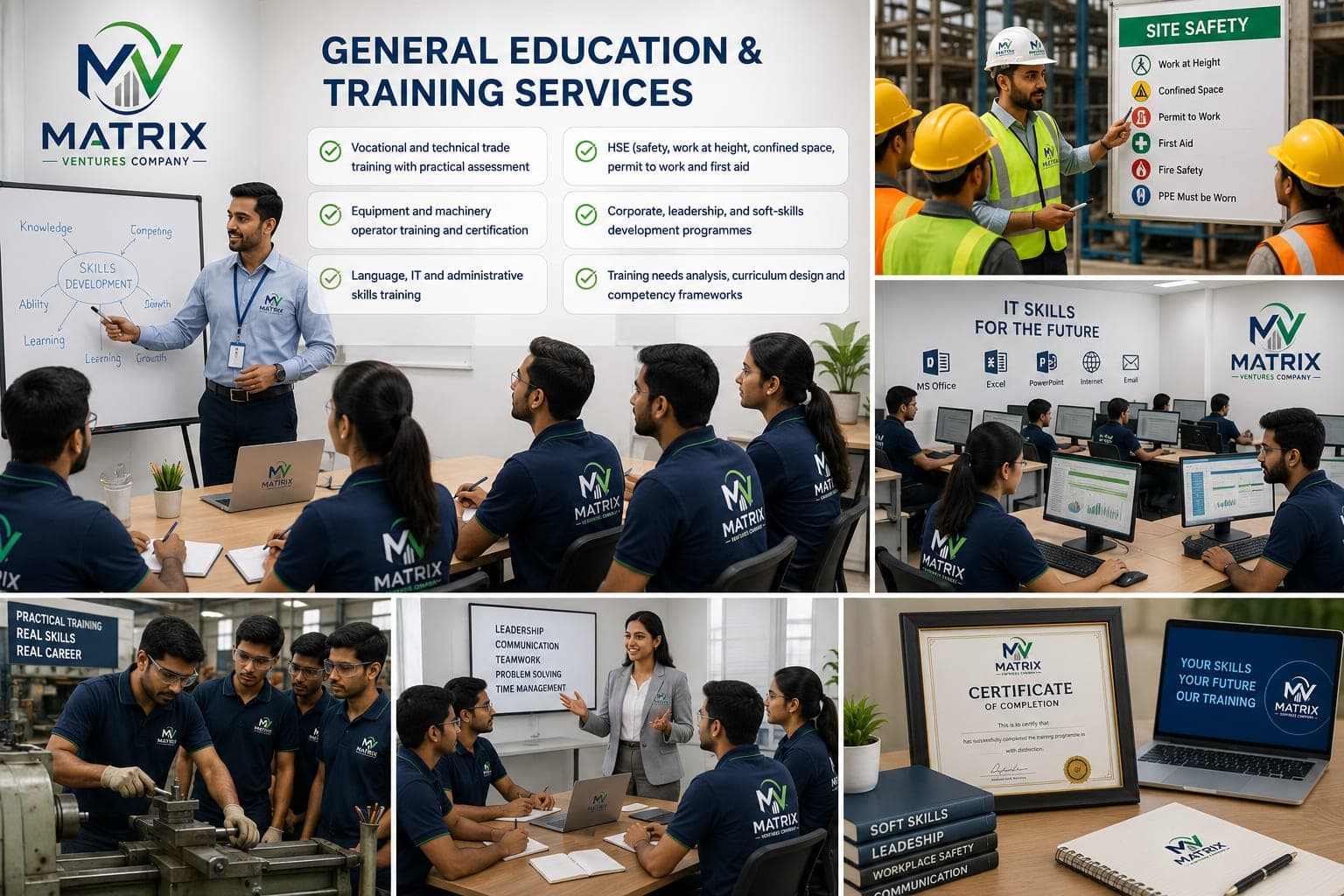
General Education & Training Services
Vocational, technical, HSE and corporate training with assessment and certification.
View details
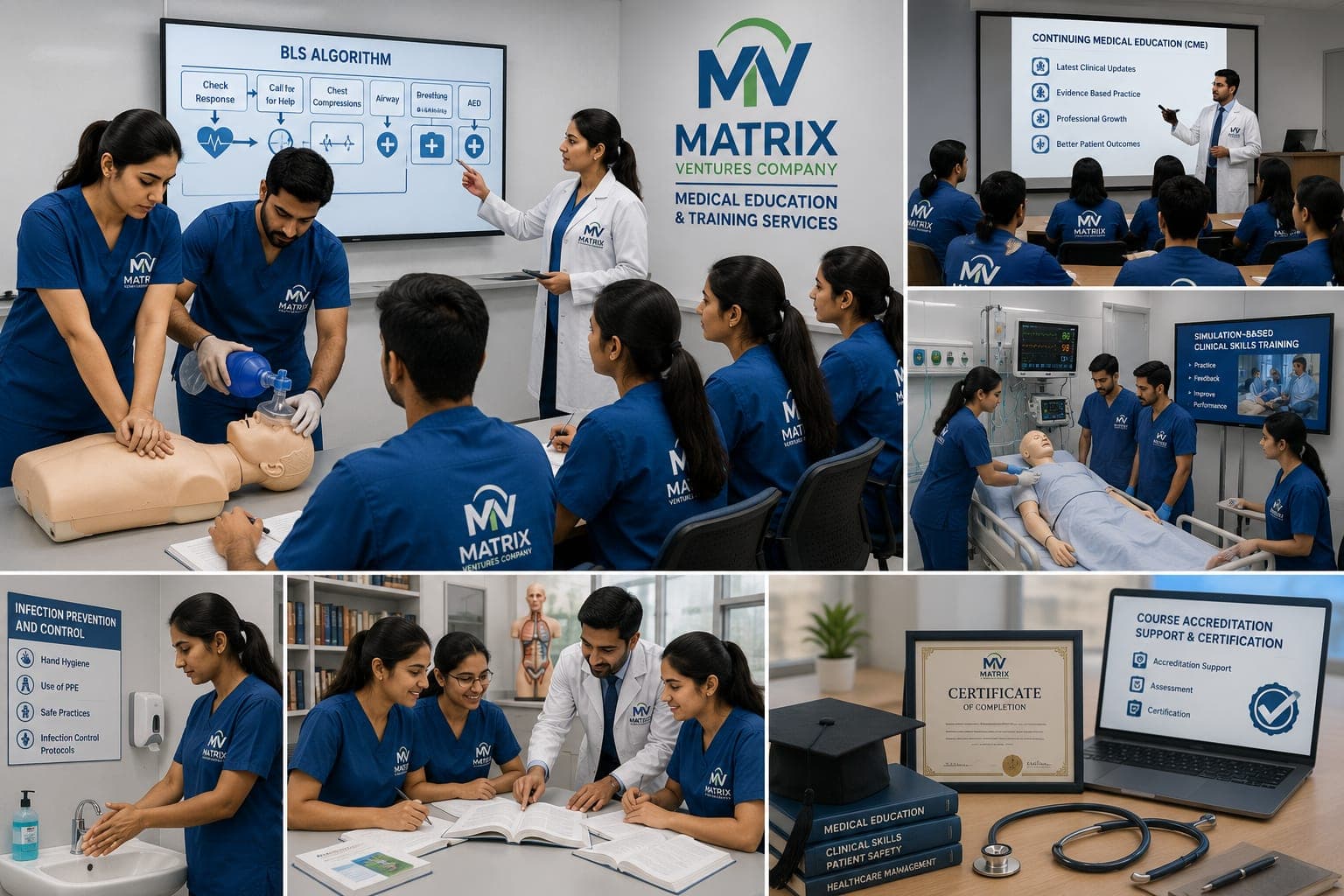
Accredited clinical training, continuing medical education and simulation-based programmes.
Clinical competence has to be taught, assessed and refreshed. We deliver structured medical training programmes — classroom, simulation and on-the-job — with assessment and certification at the end of each course.
Medical education and training is the structured development and assessment of clinical competence: resuscitation and life support certification, continuing professional development, simulation-based skills training, and infection prevention and control education. It differs from general corporate training in that competence must be demonstrated and assessed rather than attended, and in that accredited activity carries hours a practitioner needs for professional registration renewal.
Clinical skills decay measurably between uses, and the skills that decay fastest are the ones used least often — which are precisely the emergency skills that matter most when they are finally needed. A practitioner who last performed resuscitation two years ago is not as capable as their certificate suggests. This is why life support certification expires on a fixed cycle rather than being awarded once: the renewal interval exists because of the decay curve, not for administrative reasons.
Resuscitation certification, CPD programmes and competency assessment feeding accreditation evidence.
Site medic and first responder training for trauma, burns and confined-space casualty scenarios.
Simulation-based skills delivery and structured assessment supporting formal clinical programmes.
Documented competency programmes suited to public-sector reporting and audit requirements.
Screening technique training and emergency response competence for workplace clinical staff.
Workplace first aid and basic life support for non-clinical staff designated as responders.
Requirements are established from role, scope of practice, accreditation obligations, certification expiry dates and any incident or audit findings. Training driven by a calendar rather than a needs analysis tends to certify people in what they already do well.
Content, duration, assessment method and delegate-to-instructor ratio are set against the requirements of the accrediting body, so the hours awarded are recognised for registration renewal rather than delivered as unrecognised in-house training.
Knowledge is delivered in the classroom, but skills are developed on manikins and simulators and consolidated in the clinical environment. Emergency skills in particular have to be practised under time pressure, because that is the condition they will be used in.
Competence is assessed by observed performance against a checklist, not by attendance or a written test alone. A delegate who cannot demonstrate the skill does not pass — which is the only thing that makes the certificate mean anything to the facility relying on it.
Certificates are issued with the award date, expiry date and awarded hours, and a training record is supplied to the employer. Expiry tracking matters as much as the certificate: lapsed certification is one of the more common accreditation findings.
Refresher intervals are scheduled ahead of expiry rather than after it, and where a facility wants its own training function, instructors are developed internally so the capability transfers rather than remaining a permanent outsourced dependency.
Competence is demonstrated against defined criteria before a certificate is issued. A training record that cannot distinguish between attending and being competent is of no use to the facility relying on it.
Programmes are aligned to accrediting body requirements so that CPD hours are recognised toward registration renewal, rather than delivered as training that does not count when it matters.
The skills most likely to be needed in an emergency are the least practised in routine work. Simulation is the only way to rehearse them safely and under realistic time pressure.
Training can be run at the facility, which avoids releasing an entire clinical team to travel and allows scenarios to be rehearsed in the actual environment and with the actual equipment they will use.
Certification expiry is tracked and refreshers scheduled ahead of lapse, which addresses one of the most frequently raised accreditation findings before a surveyor raises it.
| Criterion | Split discipline packages | Single accountable contract |
|---|---|---|
| What the certificate proves | The delegate was present | The delegate performed the skill to criteria |
| Accreditation value | Hours may not count toward renewal | Accredited hours recognised for registration |
| Emergency readiness | Skills rehearsed without time pressure | Scenarios run under realistic conditions |
| Survey outcome | Lapsed certificates found by the surveyor | Expiry tracked and refreshed in advance |
Health practitioners require professional classification and registration with the Saudi Commission for Health Specialties to practise, and registration renewal is tied to accumulating continuing professional development hours from accredited activity. Training that is not accredited may be educationally useful but does not contribute to renewal.
The standards of the Saudi Central Board for Accreditation of Healthcare Institutions address staff credentialing, competency assessment and mandatory training such as infection prevention and control and basic life support. Surveys examine the evidence — training records, assessment outcomes and current certification — rather than the training plan.
Resuscitation courses such as BLS, ACLS and PALS are delivered under the curricula and instructor requirements of the issuing international body, through authorised training centres. Certification validity is time-limited by design, and a certificate issued outside the recognised structure may not be accepted at credentialing.
Infection prevention and control education is a standing requirement in healthcare settings, covering standard precautions, hand hygiene, isolation practice, sharps safety and waste segregation. It is typically mandatory on induction and repeated periodically, with records examined at survey.
Training does not by itself extend what a practitioner may lawfully do; scope of practice follows professional classification and registration. Programmes are therefore designed to develop competence within a practitioner's registered scope rather than to imply an expansion of it.
Codes and standards this discipline is routinely held to. The standards applied on any given project are those named in the contract.
They count where the activity is accredited by the relevant body. This is worth confirming before booking any programme, because training can be genuinely valuable educationally and still contribute nothing to a renewal requirement. Certificates should state the awarded hours and the accreditation reference so the practitioner can evidence them.
Certification is valid for a fixed period set by the issuing body, commonly two years for courses such as BLS and ACLS. The interval reflects measured skill decay rather than administrative convenience — resuscitation performance declines noticeably within months of training when the skill is not used, which is why refreshers are scheduled ahead of expiry rather than at it.
Yes, and on-site delivery is often preferable. It avoids releasing a whole clinical team to travel, and it allows scenarios to be run in the actual clinical environment with the actual equipment and layout staff will use in a real event — which frequently exposes coordination problems that a training centre never would.
It uses manikins, task trainers and scenario exercises to rehearse clinical situations without a patient present. Its value is greatest for events that are rare but high-stakes — cardiac arrest, airway emergencies, major trauma — because these cannot be learned through routine exposure and must not be practised for the first time on a real patient.
Competence is assessed. Delegates are observed performing the skill against a checklist and must demonstrate it to pass, rather than being certified for attending. This distinction is the entire point from the employer's perspective: an unassessed training record cannot tell a facility whether its staff can actually do the thing.
Yes — through instructor development, curriculum and assessment design, and support with course accreditation. For facilities training regularly, developing internal instructors is usually more sustainable than an indefinite external arrangement, and it keeps the training closer to the facility's own equipment and protocols.
Fewer than most schedules assume. Skills-based courses specify a maximum delegate-to-instructor ratio precisely because assessment requires individual observation — an instructor cannot watch twelve people perform a skill and know whether each one met the criteria. Where a facility asks for a larger group to reduce cost, the saving comes directly out of assessment quality, and the certificate becomes correspondingly less meaningful.
Because competence is a snapshot, not a permanent state. Skills decay measurably when not used, and the decay is fastest for complex, infrequently performed procedures — precisely the emergency skills that matter most. A practitioner assessed as competent two years ago and who has not performed the skill since is not currently competent, however valid the certificate remains on paper. That gap between certificate validity and actual capability is why refreshers are scheduled ahead of expiry rather than at it.