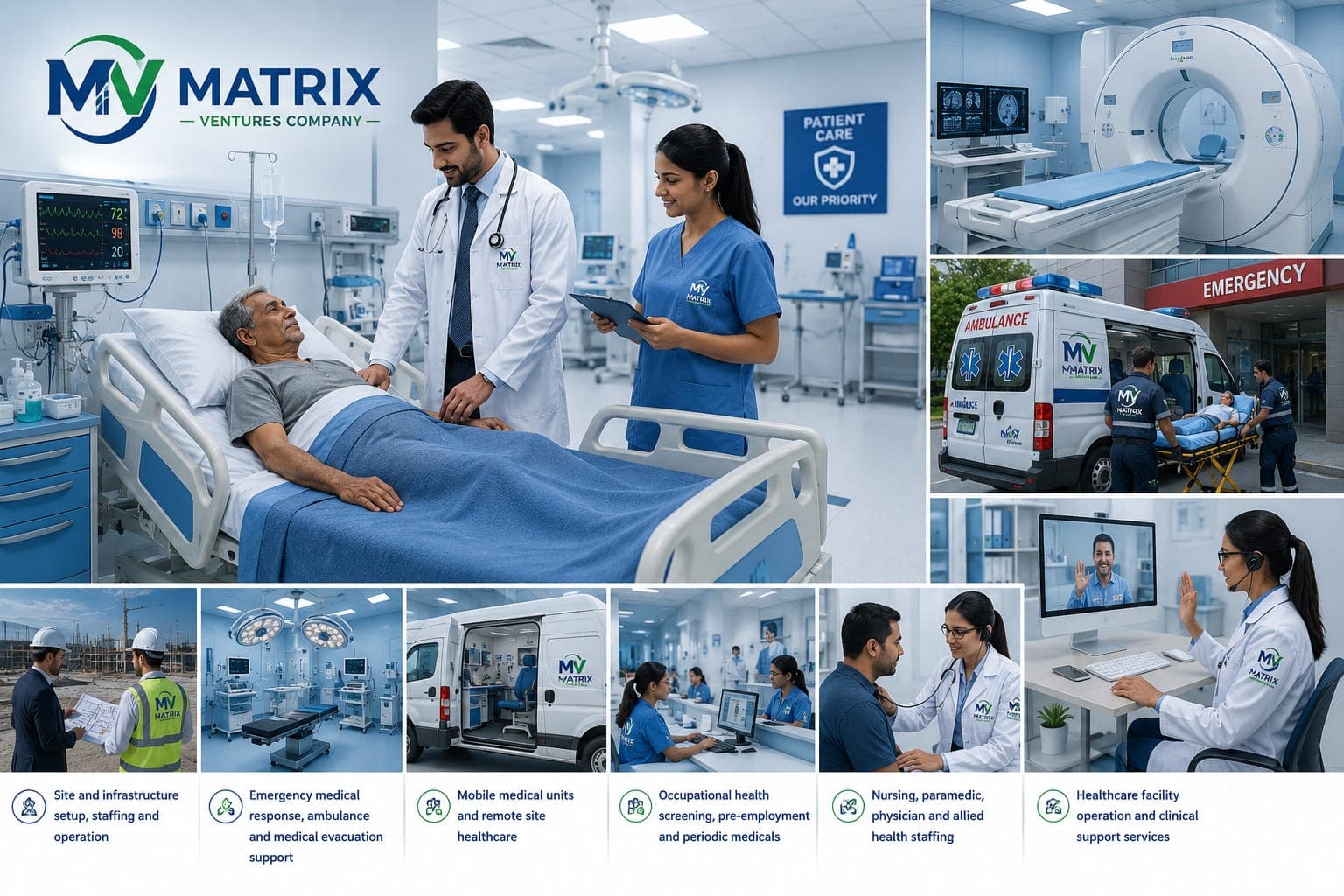
Healthcare
Medical & Healthcare Services
Occupational health, site clinics, emergency response and healthcare facility operation.
View details
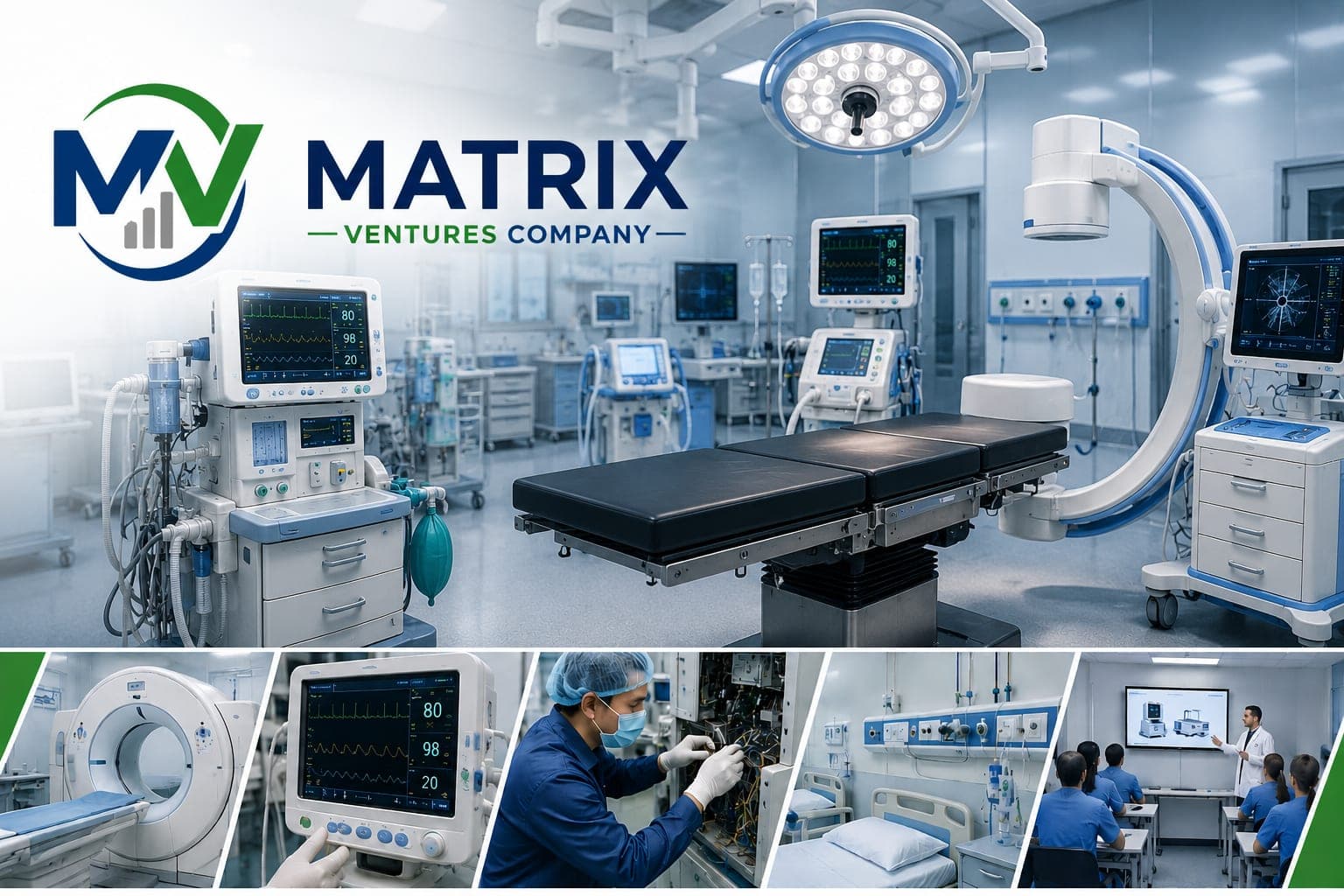
Supply, installation, calibration and biomedical maintenance of medical equipment.
Medical equipment has to be installed correctly, calibrated to specification and maintained on schedule for the life of the asset. We cover the full chain — supply, site preparation, installation, commissioning, user training and ongoing biomedical service.
Medical equipment technical services cover the full asset chain: supplying registered devices, preparing the site to receive them, installing and commissioning them, calibrating and performance-verifying them against specification, and maintaining them on a planned schedule for the life of the asset. In a clinical setting the distinguishing requirement is traceability — every calibration, repair and performance check must be evidenced, because accreditation and patient safety both depend on the record.
Medical equipment produces the numbers clinicians make decisions from. A ventilator delivering a different volume than displayed, or an analyser drifting out of calibration, does not announce itself — it produces plausible readings that are quietly wrong. That is why calibration and performance verification are scheduled activities with documented results rather than something done when a device appears faulty. Uncalibrated equipment is not neutral; it is actively misleading.
Diagnostic, imaging, theatre and ward equipment installed and maintained to accreditation-standard records.
Equipment for occupational health and emergency response at sites far from hospital support.
Analytical instrument calibration, performance verification and preventive maintenance programmes.
Procurement support, installation and documented maintenance suited to public-sector audit.
Audiometry, spirometry and screening equipment kept calibrated for periodic medical programmes.
Turnkey equipping of new centres, from site preparation through commissioning to staff training.
Clinical requirement, throughput, room constraints and integration with existing systems determine the specification. Regulatory status is confirmed at this stage — a device that is not registered for the Saudi market cannot be lawfully supplied, however suitable it appears clinically.
Power supply and quality, structural loading, shielding where radiation is involved, ventilation, cooling, drainage and medical gas connections are prepared before delivery. Equipment arriving into an unprepared room is the most common cause of installation delay.
Devices are installed, electrically safety tested, configured and commissioned against the manufacturer's acceptance criteria. Baseline performance is recorded at commissioning, since later verification is meaningless without a reference point.
Calibration is performed with instruments traceable to recognised standards, and results are recorded with as-found and as-left values. The as-found reading matters: it indicates whether the device was drifting and therefore whether results produced since the last calibration should be questioned.
A PPM schedule is built from manufacturer intervals, usage intensity and criticality, with electrical safety testing included. Life-support and critical-care devices are scheduled more conservatively than convenience equipment.
Corrective maintenance, spare parts and consumables are supported through the asset's life, and end-user and biomedical staff are trained on safe operation and first-line checks. Much reported equipment failure turns out to be operation rather than fault.
Calibration is performed against traceable standards and documented with as-found and as-left values, producing exactly the evidence an accreditation survey examines.
Power, structural, shielding, HVAC and medical gas preparation are delivered by the same organisation's engineering teams, removing the usual gap between the builder and the equipment supplier.
Device registration and, for radiation-emitting equipment, licensing requirements are confirmed during selection rather than discovered at customs or at inspection.
Supply, installation, calibration, preventive and corrective maintenance sit with one party, so responsibility for a device's performance does not fragment after the warranty period ends.
End-user and biomedical training accompanies installation, which reduces both misuse-driven faults and the downtime caused by waiting for a technician for something operational.
| Criterion | Split discipline packages | Single accountable contract |
|---|---|---|
| Measurement accuracy | Assumed correct until a fault is obvious | Verified on schedule against traceable standards |
| Accreditation readiness | Records assembled ahead of a survey | Evidence generated continuously as work is done |
| Downtime | Device out of service awaiting diagnosis and parts | Planned intervention with parts anticipated |
| Historic results | No way to know if past readings were reliable | As-found values show whether drift occurred |
Medical devices placed on the Saudi market are regulated by the SFDA, which operates device registration and marketing authorisation requirements, and licenses the establishments that import, store and distribute them. Supplying an unregistered device, or supplying through an unlicensed establishment, is a regulatory breach regardless of the device's quality.
Equipment that emits ionising radiation — X-ray, CT, fluoroscopy, mammography and similar — falls under the Nuclear and Radiological Regulatory Commission, which licenses practices and sources and sets radiation protection requirements. Room shielding design, dose monitoring and authorised personnel arrangements are part of the installation, not an afterthought.
Health facilities are licensed by the Ministry of Health and assessed against the standards of the Saudi Central Board for Accreditation of Healthcare Institutions. Equipment maintenance, calibration status and electrical safety testing records are examined during accreditation, which makes the documentation as important operationally as the maintenance itself.
Medical gas pipeline systems are safety-critical and are normally specified to ISO 7396-1 or NFPA 99. Requirements cover material cleanliness, brazing under inert purge, pressure and cross-connection testing, and verification that every outlet delivers the gas its label states — a cross-connection is a fatal failure mode, which is why verification is independent.
Medical electrical equipment safety is governed by the IEC 60601 series, and manufacturer quality systems by ISO 13485. Electrical safety testing at installation and at defined intervals is standard practice for mains-powered medical devices, particularly those with patient-applied parts.
Codes and standards this discipline is routinely held to. The standards applied on any given project are those named in the contract.
Yes. Medical devices are regulated by the SFDA and require the applicable registration or marketing authorisation before being placed on the Saudi market, and the establishments importing and distributing them require licensing. Confirming regulatory status is part of device selection, because a device blocked at import is a project delay no clinical justification will resolve.
Beyond the device itself: radiation shielding designed for the room and its occupancy, structural capacity for the equipment weight, appropriate power supply, and licensing through the Nuclear and Radiological Regulatory Commission covering the source and the practice, along with dose monitoring arrangements for staff. The licensing is a long-lead item and belongs in the project programme from the outset.
Because the as-left value only tells you the device is correct now. The as-found value tells you how far it had drifted before adjustment — which determines whether results produced since the previous calibration are reliable. A record showing only as-left conceals precisely the information a clinical governance review would need.
Yes, subject to an initial assessment covering the device's current calibration status, service history where records exist, parts availability and any manufacturer restrictions on third-party servicing. Where the history cannot be established, a baseline verification is carried out first so subsequent maintenance has a reference point.
Typically whether an equipment inventory exists, whether planned maintenance is scheduled and completed, whether calibration is current and traceable, whether electrical safety testing has been performed, and whether staff using the devices have been trained. The pattern is consistent: the survey examines evidence, so maintenance performed without records is treated the same as maintenance not performed.
Yes — installation, extension, testing and verification. The critical step is independent verification that every outlet delivers the gas its label indicates, since a cross-connection is not detectable in ordinary use and has fatal consequences. This verification is performed and documented separately from the installation itself.
The interval comes from the manufacturer's recommendation, the device's criticality and how intensively it is used, and it is not uniform across a department. A defibrillator or infusion pump on a critical-care unit is scheduled far more conservatively than a consulting-room device, because the consequence of undetected drift is different. Usage intensity also matters: the same model used continuously drifts faster than one used occasionally.
Beyond clinical suitability: whether the device is registered for supply in the Kingdom, what the site needs in power, structural loading, shielding and cooling, whether spare parts and consumables have a reliable local supply route, what the calibration and service requirements will cost annually, and whether training is included. Purchase price is often the smallest number in a device's total cost of ownership, and consumables the largest.