Healthcare
Medical Equipment Supply, Installation & Technical Services
Supply, installation, calibration and biomedical maintenance of medical equipment.
View details
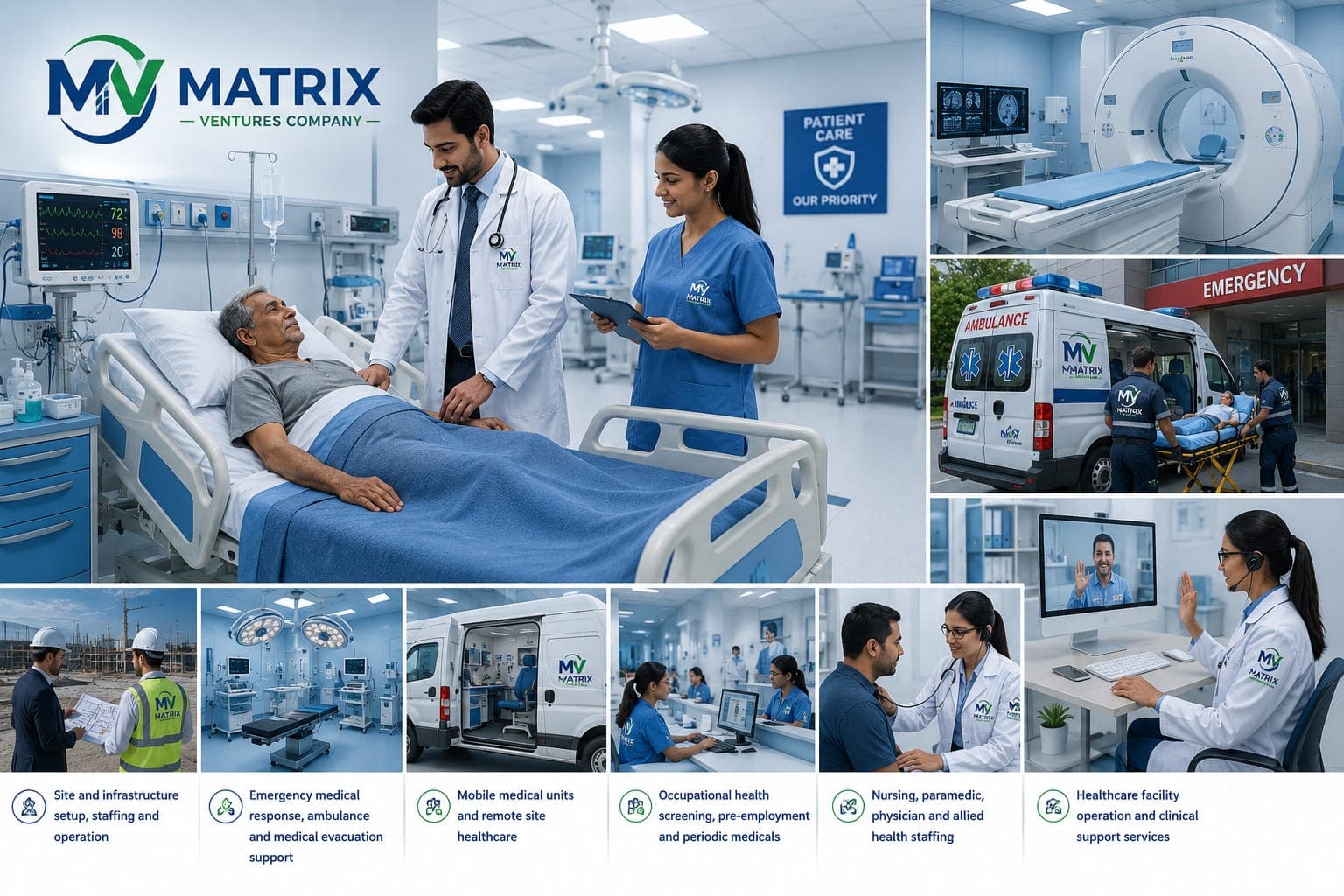
Occupational health, site clinics, emergency response and healthcare facility operation.
We provide clinical capability where it is needed, including at industrial and remote sites — staffed clinics, emergency response cover and the occupational health programmes that keep a workforce fit for duty.
Industrial and occupational healthcare is the provision of clinical capability at the workplace rather than at a hospital: a staffed site clinic, occupational health screening and periodic medicals, emergency medical response and evacuation arrangements, and the clinical staffing that runs them. On remote projects it is also the first and sometimes only medical response available, which changes how it must be resourced — capability is sized against the distance to definitive care, not against average daily demand.
On an industrial site, the clinically decisive period after a serious injury is measured in minutes, and it is spent entirely on site — before any hospital is involved. A site clinic that can stabilise and package a casualty for transfer changes the outcome; one staffed to hand out painkillers does not. Occupational health works on the opposite timescale: screening detects hearing loss, respiratory decline or heat strain while they are still reversible, long before the worker notices. Both are prevention, at different speeds.
Site clinics and emergency cover sized for chemical exposure, burns and confined-space rescue scenarios.
First response for falls, crush and heat-related illness, with periodic medicals for large labour forces.
Clinics operating as the sole medical facility, with evacuation planning as a standing arrangement.
Health surveillance for noise, dust and chemical exposure alongside routine occupational health services.
Licensed clinical, nursing and allied health staffing placed against facility requirements.
Driver fitness assessment and fatigue-related health screening for safety-critical roles.
The medical provision is scoped from the actual hazard profile, headcount, shift pattern and — critically — the distance and transfer time to definitive care. A site an hour from a hospital needs a different capability from one twenty minutes away, regardless of headcount.
The clinic is established with the treatment space, equipment, medication holdings and waste handling its scope requires, and licensed for the services it will provide. Clinical waste segregation and controlled-drug arrangements are set up at this stage, not retrofitted.
Physicians, nurses, paramedics and allied health staff are recruited and credentialed — qualifications verified, professional classification and registration confirmed, and scope of practice defined in writing so nobody is working beyond what they are registered for.
Response protocols, ambulance provision, evacuation routes and receiving-hospital arrangements are established and — importantly — exercised. A medical emergency plan that has never been drilled tends to fail at the coordination step rather than the clinical one.
Pre-employment and periodic medicals are delivered against the exposures of each role — audiometry for noise, spirometry for dust and fumes, vision for safety-critical tasks, heat tolerance where relevant — with fitness-for-work outcomes communicated to the employer without disclosing clinical detail.
Clinical records are maintained confidentially, and anonymised trends — injury patterns, hearing threshold shifts, heat-related presentations by month — are reported back so that the workplace controls can be corrected. Surveillance that never informs prevention is only paperwork.
Provision is scoped against the distance to definitive care rather than a generic headcount ratio, which is what determines whether a serious casualty can actually be stabilised on site.
Every practitioner's qualification, professional classification and registration is verified before deployment, and scope of practice is defined in writing. Unverified credentials are the single largest exposure in industrial clinical staffing.
Screening results are aggregated into anonymised trends and reported to the employer, turning surveillance into a control that actually changes exposure rather than a file of individual results.
The clinic sits inside the same organisation delivering the construction, manpower and safety scopes, so medical response is aligned with permit systems, confined-space rescue and the site emergency plan rather than sitting outside them.
Clinical records stay confidential to the practitioner while the employer receives the fitness-for-work outcome it is entitled to. Conflating the two is a common and serious error in occupational health arrangements.
| Criterion | Split discipline packages | Single accountable contract |
|---|---|---|
| Time to first clinical care | Full transfer time to the nearest facility | Minutes, on site, before transfer begins |
| Minor injury handling | A worker lost for a day to an external visit | Treated on site and returned to work |
| Occupational surveillance | Periodic medicals with results filed and unread | Trends fed back into workplace controls |
| Emergency coordination | Improvised at the moment it is needed | Drilled protocol with agreed receiving hospital |
Health facilities, including workplace and site clinics, require licensing from the Ministry of Health for the scope of services they provide. The licence defines what the facility may do; operating outside that scope is a regulatory breach even where a practitioner is individually competent to do it.
Every health practitioner in the Kingdom requires professional classification and registration with the SCFHS in order to practise, at the level their qualifications and experience support. Registration also carries continuing professional development requirements for renewal, so credentialing is an ongoing obligation rather than a one-time check at hiring.
Healthcare facilities are assessed against the standards of the Saudi Central Board for Accreditation of Healthcare Institutions, covering patient safety, infection prevention and control, medication management, staff credentialing and clinical record keeping. These standards shape how a clinic operates day to day, not only how it performs at survey.
Employers carry duties under the Labour Law and its occupational safety and health provisions to protect workers from work-related harm, which in practice includes health surveillance where exposures warrant it. Occupational injuries and diseases interact with the General Organization for Social Insurance framework, so proper documentation matters to the worker's entitlement as well as to compliance.
Clinical waste must be segregated, stored and routed to licensed disposal under environmental and health requirements. Medication holdings — particularly controlled drugs — are subject to storage, recording and accountability requirements, which apply equally to a small site clinic and a hospital pharmacy.
Codes and standards this discipline is routinely held to. The standards applied on any given project are those named in the contract.
Primarily the hazard profile and the transfer time to definitive care, with headcount and shift pattern as secondary factors. A site an hour from a hospital needs the ability to stabilise and package a serious casualty independently; a site twenty minutes from an emergency department can rely more on rapid transfer. Scoping on headcount alone consistently under-provisions remote projects.
Yes. Professional classification and registration with the Saudi Commission for Health Specialties is a prerequisite for practising in the Kingdom, and it is verified before deployment rather than assumed from a qualification certificate. Scope of practice is also defined in writing, so nobody is working beyond the level they are registered at.
Clinical records remain confidential to the practitioner. The employer receives a fitness-for-work outcome — fit, fit with restrictions, or not fit for the specific role — without the underlying clinical detail. This distinction is important both ethically and practically: workers who believe screening results go to their employer tend to under-report symptoms, which defeats the purpose of surveillance.
It is built from the exposures of each role. Common components are pre-employment fitness assessment, audiometry where noise exposure exists, spirometry for dust or fume exposure, vision testing for safety-critical tasks, and monitoring related to heat stress. Periodic repetition is what gives it value, because the finding that matters is usually a change from the individual's own baseline rather than a single abnormal result.
Yes — emergency medical response, ambulance cover and medical evacuation support, with receiving-hospital arrangements agreed in advance. The part most often neglected is exercising the plan: a plan that has never been drilled usually fails at coordination — who calls whom, where the ambulance enters, who meets it — rather than at the clinical step.
Yes. Physicians, nurses, paramedics and allied health staff can be supplied into a client-operated facility, with credentialing and registration verification handled as part of the placement. Full clinic setup and operation is available as the alternative where the client would rather not run the facility itself.
Through a combination of scheduling, hydration, acclimatisation and surveillance. The declared midday work restriction in summer is the legal floor, not the whole control — heat illness also occurs outside those hours, particularly in workers newly arrived from cooler climates who have not acclimatised, and in those working in PPE that prevents evaporative cooling. Site clinics see the early presentations, which is why clinic data should feed back into work scheduling.
A first aider is a trained non-clinical worker who can deliver immediate basic care while professional help is summoned. A site medic or nurse is a registered health practitioner working within a defined clinical scope, able to assess, treat and make transfer decisions. The distinction matters when scoping cover: a remote site with only first aiders has no clinical decision-making capability on hand, however well trained those first aiders are.