
Facilities & Support Services
Facilities Management & Housekeeping Services
Integrated hard and soft facilities management for operational assets.
View details
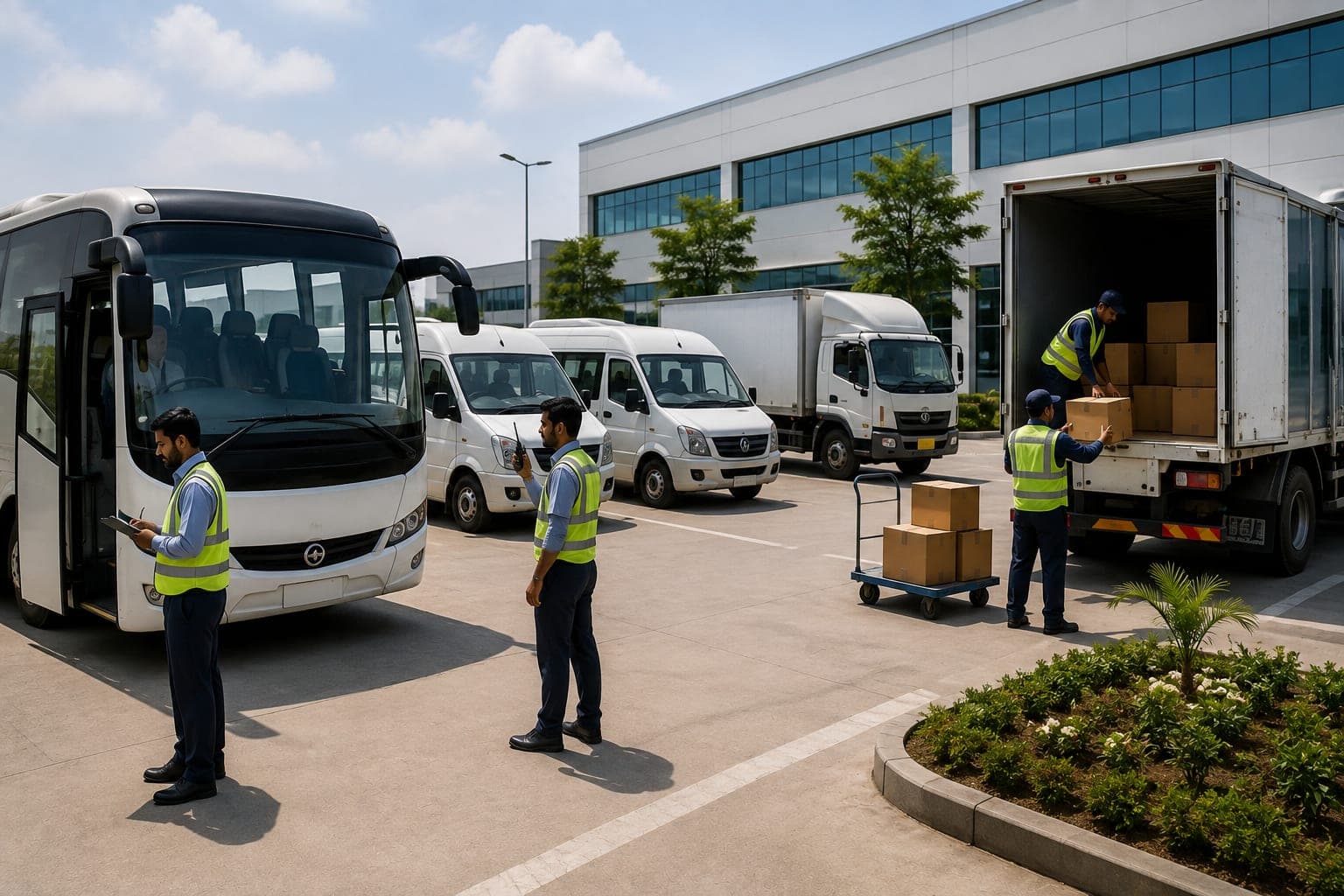
Passenger, staff and cargo transport with managed, maintained and tracked fleets.
We operate transport as a managed service, not a vehicle rental. Routes, drivers, maintenance schedules and tracking are our responsibility; the client receives a reliable service against an agreed timetable.
Transportation services cover the movement of people, cargo and equipment that a project or operation needs to run: scheduled workforce transport to site, executive and passenger transport with professional drivers, haulage of materials and heavy equipment, and the fleet management that keeps vehicles licensed, serviced and insured. It is distinguished from a taxi arrangement by the fixed schedules, licensed drivers, maintained fleet and safety oversight a workforce movement actually requires.
Workforce transport is usually treated as logistics, but it is where a large share of a contractor's road exposure actually sits — moving dozens or hundreds of people twice a day, often before dawn and after dark, on routes shared with other traffic. A single serious road incident involving a workforce bus carries consequences far beyond the schedule impact of a late shift. Transport safety is therefore managed with the same rigour as site safety, not treated as an administrative afterthought.
Workforce buses to remote plant locations and permitted haulage of oversized equipment for turnarounds.
Daily shift transport for large labour forces and haulage of plant, formwork and bulk materials.
Shift-pattern employee transport and inbound/outbound material movement between facilities.
Executive and client transport with professional drivers and vetted, well-presented vehicles.
Staff shuttle services and patient or non-emergency transport under defined safety protocols.
Scheduled haulage runs integrated with a wider supply chain or site logistics operation.
Pick-up points, shift timings, headcount and route options are mapped before vehicles are assigned, with journey times validated against actual road conditions rather than a straight-line estimate.
Vehicles are matched to the load — passenger count, cargo type, route terrain — and licensed drivers are assigned with the correct class of licence for the vehicle they operate.
Vehicles undergo a documented pre-trip check — brakes, tyres, lights, load securing — before every journey, not only at scheduled service intervals. A defect found on the road is a defect that should have been found in the yard.
GPS tracking, journey management and driver-behaviour monitoring run in real time, with speed, harsh braking and route deviation flagged for follow-up rather than reviewed only after an incident.
Preventive servicing, istimara renewal, periodic vehicle inspection and insurance are tracked against expiry dates so a vehicle never operates on an expired document. This is fleet administration done as a schedule, not a reaction to a checkpoint fine.
Near misses and incidents are investigated for root cause — driver behaviour, route hazard, vehicle condition or scheduling pressure — and corrective action is tracked to closure rather than treated as isolated events.
Driver vetting, journey management and incident investigation follow the same rigour applied to site safety, because road exposure is treated as an occupational hazard rather than a logistics detail.
Licensing, servicing and insurance are tracked against expiry rather than discovered lapsed at a checkpoint or after a claim, which is where fleet arrangements most often unravel.
Vehicle and driver numbers flex with a mobilisation peak or demobilisation, avoiding the cost of an owned fleet sized for a demand level that does not persist.
GPS and driver-behaviour records provide the evidence some clients and insurers specifically require, rather than an assurance with nothing behind it.
Workforce transport, executive transport and equipment haulage are coordinated by the same operation, useful where a project needs all three without managing separate suppliers.
| Criterion | Split discipline packages | Single accountable contract |
|---|---|---|
| Driver competency | Assumed from possession of a licence | Licence class verified, record checked, route inducted |
| Vehicle condition | Serviced when a fault appears | Preventive schedule plus documented pre-trip checks |
| Compliance documents | Discovered expired at a checkpoint | Tracked against expiry across the fleet |
| Breakdown response | Improvised; a shift can be stranded | Standby vehicle and recovery arranged in advance |
| Safety evidence | None available if a client or insurer asks | GPS and driver-behaviour records retained |
Vehicle operation is governed by the Saudi Traffic Law under the General Directorate of Traffic, which sets licence classes for different vehicle types, speed and load limits, and the offences that attach to commercial transport specifically.
Commercial passenger and freight transport activities fall under the licensing framework of the Transport General Authority, covering the operator's own licensing, vehicle permits and the conditions attached to carrying passengers or goods for a fee.
Vehicles require periodic technical inspection to remain licensed for road use, alongside valid registration (istimara) and insurance. A commercial fleet carries this obligation across every vehicle simultaneously, which is why it needs administering as a system rather than tracked per vehicle informally.
Moving oversized equipment or hazardous materials requires specific permits and routing approval, with load securing and escort arrangements where the load or route demands it. Moving without the correct permit is a common and entirely avoidable cause of delay and penalty.
Driving time falls within Labour Law working-hour limits, and fatigue is a recognised road-safety risk in its own right — particularly relevant to workforce transport running early-morning and late-night shift patterns. Rostering that ignores rest periods creates the exact exposure the transport arrangement exists to avoid.
Codes and standards this discipline is routinely held to. The standards applied on any given project are those named in the contract.
Yes. This typically involves mapping pick-up points against camp or accommodation locations, sizing the fleet to shift-change peaks rather than average demand, and building in route redundancy so a single vehicle breakdown does not strand a shift.
Through licence verification for the correct vehicle class, background and driving-record checks, and induction to the specific routes and site rules the driver will operate under. For heavy or oversized loads, specific competency and permit requirements apply on top of the standard licence.
A contingency plan — a standby vehicle, a recovery arrangement, and a communication protocol to the client — is established before the route runs, not improvised when the breakdown happens. Fleet monitoring is what allows a backup vehicle to be dispatched before the delay becomes serious.
Both, as a managed service — vehicles, licensed drivers, servicing, licensing and insurance administration together — or drivers alone where a client already operates its own fleet. The arrangement is scoped to what the client actually needs managed.
Yes, including the permit application, route survey and, where the load requires it, escort arrangements. Oversized loads are planned days or weeks ahead of the move, since permit approval and route clearance are rarely same-day processes.
Continuously. Speed, harsh braking, route adherence and journey duration are monitored in real time so that risky behaviour is corrected through coaching before it produces an incident, rather than reviewed afterwards as evidence.
Through rostering that treats driving hours as working hours and builds in rest periods, rather than scheduling a driver across both ends of a day because the vehicle was available. Workforce transport runs precisely at the hours when fatigue risk peaks — before dawn and after dark — so rest scheduling is a safety control, not an HR formality.
Under a managed service the provider carries it — registration renewal, periodic technical inspection and insurance are tracked against expiry dates across the whole fleet as a scheduled administrative function. This matters because the exposure is simultaneous: a fleet does not have one expiry date, it has one per vehicle, and informal tracking fails at scale rather than gradually.
Facilities & Support Services
Integrated hard and soft facilities management for operational assets.
View details
Facilities & Support Services
Sourcing, mobilisation and full sponsorship management of skilled and general manpower.
View details
Facilities & Support Services
Industrial catering, camp accommodation and hospitality support under food-safety controls.
View details